UFC Betting Odds Comparison: How to Shop Lines Across UK Bookmakers
 Available in US
I backed a lightweight fight in 2023 at 2.10 with one bookmaker, only to discover that a second operator had the same fighter at 2.30, a 10% difference in return on the same outcome. One bet. Same fighter. Same result. Twenty percent more profit if I had spent thirty seconds checking another app. The global MMA betting handle hit $10.3 billion in 2024, and yet most bettors still place every UFC wager with whichever bookmaker they happen to have open. Line shopping is the simplest, most reliable edge in betting, and it costs nothing except a few minutes of your time.
Why UFC Odds Vary Between UK Bookmakers
If you have only used one bookmaker, you might assume that odds are standardised, that every operator charges the same price for the same fight. They do not. The global MMA betting handle of $10.3 billion is distributed unevenly across operators, and each bookmaker’s UFC pricing reflects a different combination of their risk exposure, their customer base, and their trading desk’s assessment of the fight.
UFC replaced DraftKings with bet365 as its official betting partner in 2025, per SponsorUnited, a deal that gives bet365 preferential access to data and promotional placement. That partnership does not mean bet365 offers the best odds on every fight, it means they have the highest UFC-specific betting volume, which often leads to tighter pricing on the favourites (where public money concentrates) but not necessarily on the underdogs or secondary markets.
Other operators, particularly those with smaller UFC betting volumes, may offer longer odds on underdogs because they have less exposure to balance. A bookmaker with a hundred thousand pounds of UFC bets on a card manages risk differently from one with ten million. The smaller operator can afford to be more generous on individual prices because the absolute liability is manageable.
A third factor is timing. Operators open their UFC lines at different times during fight week, and early movers set prices with less market information. A bookmaker that opens its line on Monday may offer a different price from one that waits until Wednesday, by which point public money and sharp bettor activity have already shaped the market. Checking odds across operators at the same moment eliminates the timing variable and reveals pure pricing differences.
Using Odds Comparison Tools for UFC
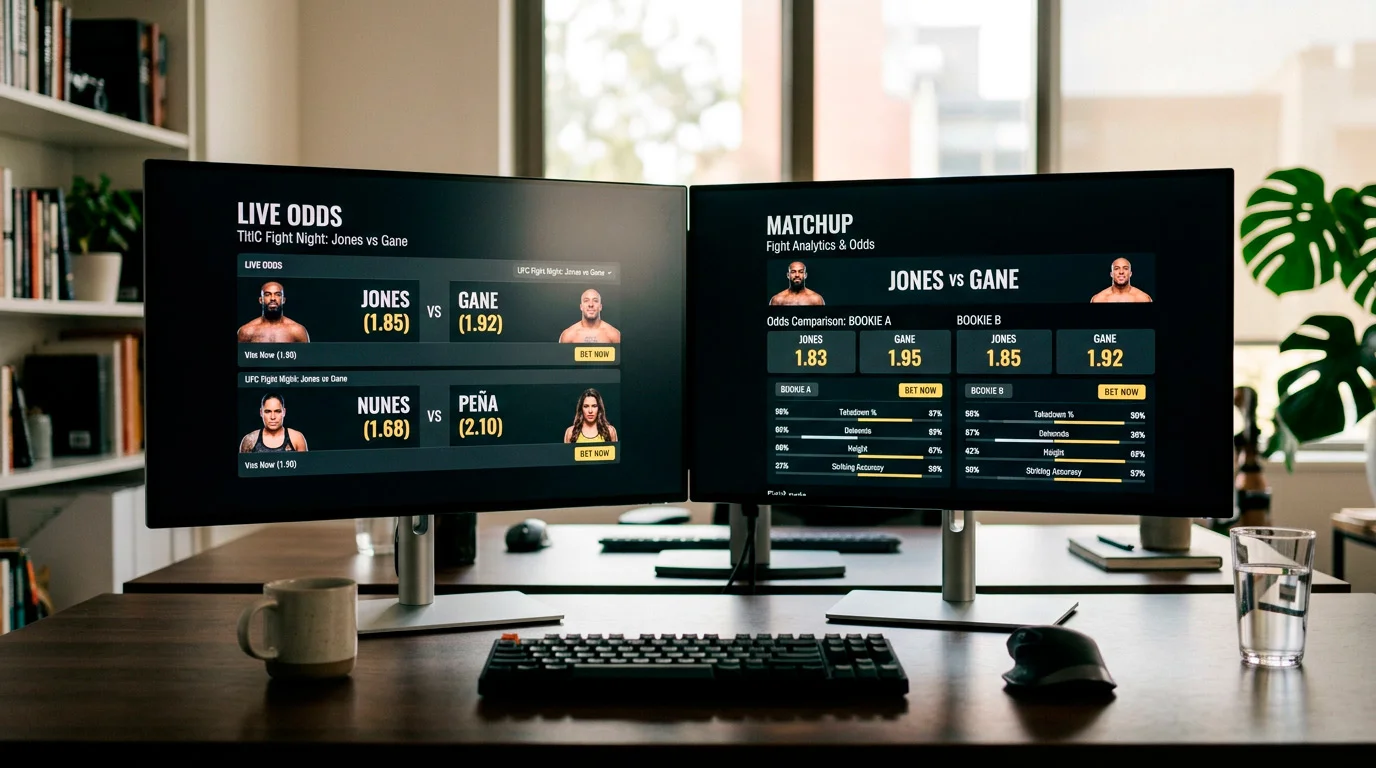
Manual comparison – opening three or four apps and checking the same fight – works but is tedious. Odds comparison tools aggregate pricing from multiple operators onto a single page, showing you the best available odds for each selection at a glance. Several of these tools are free and accessible without an account.
When using a comparison tool for UFC, check three things. First, does the tool update in real time or on a delay? A tool showing odds that are fifteen minutes old is worse than useless during fight week when lines move on breaking news. Second, does the tool cover the operators where you actually hold accounts? A comparison that shows you the best price on an operator you have not signed up with is informative but not actionable. Third, does the tool include secondary markets, method of victory, over/under, round betting – or only moneylines? The biggest pricing inefficiencies in UFC often sit outside the main market.
I use comparison tools as a screening step. Before fight week, I pull up the main card fights and note which operators are outliers – either significantly shorter or longer than the consensus. The outliers become my targets for further investigation: is the operator mispricing the fight, or do they have information (or liability exposure) that the others do not? That question drives my research process for the rest of the week.
The Long-Term Impact of Line Shopping on Returns
The maths behind line shopping is unglamorous but powerful. If your average edge per bet is 3% (meaning you are making profitable selections over time), but you consistently take odds that are 2% below the best available price, you have functionally halved your long-term return. That 2% difference, bet after bet, compounds into a significant gap over a season of fight cards.
To quantify this: on a hundred bets at ten pounds each, the difference between always taking the best available price and always taking the average price across operators typically amounts to forty to sixty pounds in additional profit. That is four to six extra units added to your bankroll simply by checking a second screen before confirming each bet.
Line shopping also acts as a built-in discipline mechanism. The thirty seconds you spend comparing prices is thirty seconds where you are not acting on impulse. It creates a pause between the decision to bet and the execution, during which you can reconsider the selection itself. Some of my best “bets” have been the ones I did not place, because the comparison process revealed that even the best available price was not good enough to justify the wager.
I have tracked my results both with and without line shopping over extended periods. The improvement is consistent, measurable, and entirely attributable to price optimisation rather than selection quality. If you do nothing else to improve your UFC betting in 2026, start shopping your lines across at least three operators. The odds format guide explains how to convert between fractional, decimal, and American formats when comparing prices across operators that display odds differently.
How much difference do UFC odds typically show between UK bookmakers?
On moneyline bets for main-card fights, the gap between the best and worst price across major UK operators typically ranges from 5% to 15% of the implied probability. On secondary markets like method of victory and round betting, the gap can be wider because fewer operators price these markets and the volume-driven correction is smaller.
Are betting exchange odds on UFC usually better than bookmaker odds?
Exchange odds can be better because they eliminate the bookmaker’s built-in margin – you are betting against other punters, not against the house. However, exchanges charge a commission on winning bets, and UFC liquidity on exchanges is lower than on football or horse racing, which means large bets may not be fully matched at the displayed price.
When is the best time to lock in UFC odds?
There is no single best time. Opening lines on Monday or Tuesday can offer early-week value before sharp money moves the price. Closing odds on Saturday reflect the most information but are tighter. The practical approach is to check odds at opening and again on fight day, locking in whichever price is better for your selection.
Published by the ufc Betting uk team.