UFC Betting Markets Explained: Every Bet Type Available to UK Punters
 Available in US

When I started betting on UFC fights in the mid-2010s, you had two options at most UK bookmakers: pick the winner or leave. No method of victory, no round betting, no props. The market has matured enormously since then, driven partly by the sport’s explosive growth – the global MMA betting handle reached $10.3 billion in 2024, per industry reports, and partly by bookmakers recognising that UFC bettors want the same depth of markets available for football or horse racing.
That depth creates opportunity, but it also creates confusion. A busy UFC fight card can generate dozens of individual markets per bout, and each one carries its own pricing logic, its own risk profile and its own potential for mispricing. UFC GGR has been compounding at above 18% annually over the past five years according to Fight Matrix, which means the volume and sophistication of these markets will only increase.
This guide walks through every major bet type available to UK punters – from the moneyline foundation through method of victory, round betting, over/under totals, props, futures and accumulators. For each market, I will explain the mechanics, show you how it is priced, and flag the tactical considerations that separate informed bets from guesses.
Table of Contents
- Moneyline (To Win): The Foundation Market
- Method of Victory: KO/TKO, Submission, Decision
- Round Betting and Round Groups
- Over/Under Total Rounds
- Proposition Bets: Fight-Specific and Fighter Props
- Futures and Outright Markets
- UFC Accumulators: Building Multi-Fight Parlays
- Comparing Market Depth Across UK Bookmakers
- Questions About UFC Betting Markets
Moneyline (To Win): The Foundation Market
Every other UFC market is built on top of this one. The moneyline is a straight pick: which fighter wins the bout? No method, no round, no conditions, just the outcome. If your fighter wins by first-round knockout or by split decision after fifteen minutes of grappling, the moneyline pays the same.
That simplicity is both its strength and its limitation. The moneyline is the most liquid UFC market, which means the pricing is generally the sharpest and the overround is the lowest. For main events and pay-per-view headliners, moneyline overrounds at competitive UK bookmakers typically sit between 3% and 5%. For undercard bouts, that margin can widen to 7% or beyond.
The tactical consideration most bettors miss is that the moneyline price already embeds all possible methods of victory into a single number. When you back a fighter at 2.40 on the moneyline, you are buying the combined probability of them winning by knockout, submission and decision. If you believe a fighter’s primary path to victory – say, knockout, is underpriced but their decision probability is fairly valued, you might get better value from a method-of-victory bet than from the moneyline. The moneyline is the right choice when you believe the overall win probability is mispriced, regardless of how the fight ends.
One pattern I track closely: moneyline value on moderate underdogs between 2.20 and 3.50. This range captures fighters the market considers unlikely to win but far from hopeless. In my experience, this is the zone where the market’s errors cluster most densely, because the public’s bias toward favourites compresses favourite prices and inflates underdog prices beyond what the true probabilities justify.
Method of Victory: KO/TKO, Submission, Decision
This is where UFC betting gets genuinely interesting – and where I have found some of my best long-term edges. Instead of simply picking the winner, you are predicting how the fight ends. The three primary outcomes are KO/TKO (referee stoppage due to strikes), submission (the opponent taps out or is choked unconscious) and decision (the fight goes the full distance and is scored by judges).
Most bookmakers offer a six-way market: Fighter A by KO/TKO, Fighter A by submission, Fighter A by decision, and the same three options for Fighter B. Some also offer a “double chance” variant where you can back a fighter to win by two of the three methods, a useful hedge when you are confident about the winner but uncertain about the path.
The pricing dynamics of this market are revealing. KO/TKO outcomes tend to be the most popular with the public, which means knockout prices can be compressed – offering less value than the true probability justifies. Decision outcomes, by contrast, are chronically underbet because they lack the excitement factor. I have consistently found that backing the decision market in fights between two high-volume strikers with strong chins offers above-average returns, precisely because the public underestimates how often these fights go the distance.
Submission markets sit in between. They attract less casual interest than knockouts but more than decisions, and the pricing tends to be more accurate because the pool of realistic submission outcomes is smaller and easier for bookmakers to model. The value in submission markets usually appears when a specialist grappler faces an opponent with a known submission defence weakness, situations where the bookmaker’s model may not fully account for the specific grappling matchup. For a deeper look at how to exploit these patterns, I have written a dedicated breakdown of method of victory betting.
Round Betting and Round Groups
If method of victory asks “how does the fight end,” round betting asks “when.” You are predicting the specific round in which the fight is finished – or, in the grouped variant, whether the finish occurs within a range of rounds. It is one of the highest-variance markets in UFC betting, and the prices reflect that: individual round bets routinely pay 8.00, 12.00, even 20.00 and above.
Round group betting softens the variance by letting you back a range, rounds 1-2, rounds 3-4 for a five-round fight, or “goes the distance” as an alternative to picking the exact round. The prices are lower than individual round bets but still substantially higher than moneyline or method markets.
Pricing round betting accurately is exceptionally difficult for bookmakers, and that difficulty creates pockets of value. The key data points are each fighter’s finish rate, their typical round of stoppage and the opponent’s durability profile. A fighter who has finished four of their last five opponents in the first round will see tight pricing on round 1 but potentially generous prices on rounds 2 and 3 – because the model weights recent finishes heavily, but fighters who face tougher competition sometimes take longer to find the finish.
My general approach to round betting is selective. I avoid it on most fights because the variance is too high for systematic profitability. But when I identify a fight with a very specific finishing dynamic, a pressure grappler who smothers opponents but typically needs two rounds to establish control, facing a striker who fades badly after the first eight minutes – round 2 or the round 2-3 group can offer genuine value at prices the moneyline cannot match.
One thing to note about five-round championship and main event bouts: the round betting market expands from three rounds to five, which dilutes the probability of any individual round and pushes prices higher across the board. Championship fights also tend to produce more late finishes because the pace is different, fighters who know they have 25 minutes often start conservatively and build intensity. If your analysis points toward a late stoppage, the round 4 or round 5 prices in a title fight can offer exceptional value relative to the three-round card.
Over/Under Total Rounds
Total rounds markets ask a simpler question than round betting: will the fight last longer or shorter than a specified threshold? The standard line for a three-round bout is 1.5 rounds (sometimes 2.5), and for a five-round fight it is typically 2.5 or 3.5 rounds. If the fight finishes before the midpoint of the specified round, the under pays. If it goes beyond, the over pays.
This market strips away the need to pick a winner entirely. You are betting on fight duration, which depends on both fighters’ combined tendencies – finish rate, durability, cardio, fighting style. Two power punchers in a heavyweight bout create a strong under case. Two defensive grapplers at lightweight create a strong over case. The analysis is about the matchup dynamic, not the individual.
The distinction between 1.5 and 2.5 in a three-round fight is significant. Over 1.5 rounds requires only that the fight reaches the second round’s midpoint, which happens in the vast majority of UFC bouts. The pricing on over 1.5 is usually tight, reflecting that high base rate. Over 2.5 rounds is a meaningfully different proposition because it requires the fight to reach deep into the final round, and the pricing here often shows more interesting value.
I find the over/under market most useful as a complementary bet alongside a moneyline or method position. If I back a fighter on the moneyline because I believe their grappling will neutralise their opponent’s striking, I might also back the over on rounds because grappling-heavy fights tend to last longer. The two bets are correlated but not identical – the moneyline can win even if the over loses (quick submission), and vice versa. Used carefully, this kind of multi-market approach diversifies your exposure within a single fight.
Proposition Bets: Fight-Specific and Fighter Props
Props are the wild frontier of UFC betting, highly specific wagers on individual events within a fight rather than the fight’s outcome. Will there be a knockdown? Will the fight go to a decision? Will Fighter A land over 85.5 significant strikes? These markets barely existed for UFC a few years ago. Now they are standard on major UK platforms for pay-per-view main cards.
Fight-specific props cover events that apply to the bout as a whole: will the fight end inside the distance, will there be a knockdown in the fight, will the fight go to a decision. Fighter-specific props target individual performance metrics: total significant strikes over/under, takedowns attempted over/under, or whether a specific fighter records a knockdown.
The analytical edge in prop markets is substantial because bookmakers price them with less sophistication than moneylines. Moneyline pricing benefits from deep liquidity, multiple sharp opinions and extensive historical modelling. Prop pricing is thinner – fewer bets, less sharp money, wider margins. If you can build a statistical profile of each fighter’s performance metrics and compare it to the prop lines, you will find regular mispricing.
A word of caution: prop markets also carry wider overrounds, so the mispricing needs to be significant to overcome the margin. Betting a prop where you estimate a 52% edge against a 48% implied probability is not worth it when the overround is 8%. The value needs to clear a higher bar than in moneyline markets. I treat props as opportunistic, I check them on every card, but I only bet them when the discrepancy between my estimate and the market is substantial.
The most underexploited prop market, in my experience, is “fight goes the distance.” This is effectively a yes/no bet on whether the full number of rounds will be completed. For fights between two durable, defensively sound fighters at lighter weight classes, the “yes” option is frequently mispriced because the public gravitates toward finish-related markets and bookmakers set the “goes the distance” line as a secondary product rather than a primary pricing focus. If you build a database of finish rates by weight class and fighter profile, this market alone can produce a steady stream of small-edge bets across the season.
Futures and Outright Markets
Futures betting in UFC means wagering on which fighter will hold a divisional championship at a future date. Unlike fight-by-fight markets, futures lock your money up for weeks or months – sometimes longer, because the outcome depends on multiple fights that have not yet been scheduled.
UFC generated $1.502 billion in revenue in 2025 according to TKO Group Holdings’ earnings report, with an EBITDA margin of 57%. The organisation’s financial health underpins the stability of its event calendar and divisional structure, which matters for futures bettors because cancelled or rescheduled title fights directly affect your position. The global UFC market is projected to reach $2.79 billion by 2033 per Future Data Stats, which suggests the competitive landscape and title pictures will only become more complex.
The best time to enter a futures market is immediately after a title fight. The new champion’s odds are shortest right after a dominant defence, but challenger prices often reset to generous levels before specific matchups are announced. If you have a view on which contender will eventually fight for the belt – based on ranking trajectory, stylistic matchup with the champion, and promotional momentum, early entry captures value that evaporates once a bout is officially announced.
The risk with futures is opportunity cost. Money tied up in a futures position cannot be deployed on fight-by-fight value bets. I keep my futures exposure to a maximum of 5% of bankroll at any given time and treat them as a supplement to my core activity, not a replacement for it.
UFC Accumulators: Building Multi-Fight Parlays
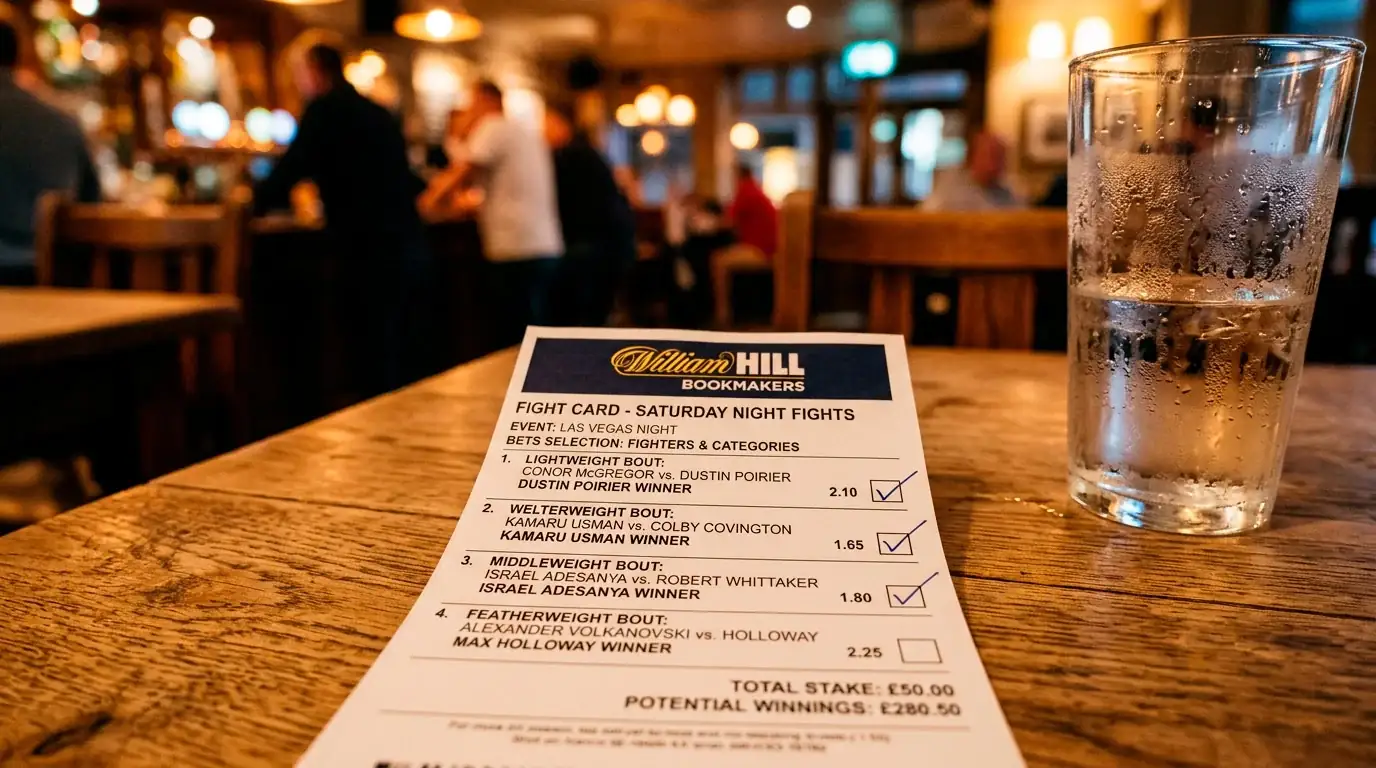
Accumulators – or parlays, in American terminology, combine multiple selections into a single bet where all legs must win for the bet to pay. The appeal is obvious: a four-leg accumulator of 1.50 favourites pays roughly 5.06 combined, turning a small stake into a larger return. The reality is harsher: each additional leg multiplies your risk, and in a sport where upsets happen more frequently than the market prices suggest, long accumulators are a reliable way to donate money to your bookmaker.
That does not mean accumulators are always a bad idea. A two- or three-leg accumulator built from genuine value bets – not just your three favourite fighters on the card, can be a reasonable way to amplify returns when you have identified multiple edges on the same event. The key is that every leg must carry positive expected value individually. If even one leg is a neutral or negative expectation bet included because “it should be a safe win,” the accumulator’s overall expected value drops below what you would earn from singles.
Correlation is the hidden trap. UFC fights on the same card are technically independent events, so combining them in an accumulator should be mathematically sound. But psychological correlation exists: if the early fights on a card produce a string of upsets, bookmakers may adjust their live lines on later fights, and the general “anything can happen tonight” atmosphere can influence both fighter mentality and your own emotional state. These are soft factors, but they compound the mathematical challenge.
My rule on accumulators: never more than three legs, never include a fight where my edge is below five percentage points, and never stake more than half a unit. Accumulators are entertainment with a mathematical foundation – not the foundation itself. For the punter treating them as a core strategy, I would point toward a more sustainable approach: flat-stake singles on value bets across the card.
Comparing Market Depth Across UK Bookmakers
Not every bookmaker offers every market on every fight, and the differences can be substantial. For a pay-per-view main event, most major UK operators will offer moneyline, method of victory, round betting, over/under rounds and a selection of props. For a Fight Night preliminary bout, some operators strip back to moneyline only, or skip the fight entirely.
UFC pricing is inherently less precise than football or tennis because the number of variables in a fight – stance, reach, cardio, chin durability, grappling pedigree, resists simple modelling. The analytical platform Unabated has described UFC odds as among the hardest in sport to price accurately, and that challenge is amplified for secondary markets like props and exact round betting, which require more granular modelling. Some bookmakers invest heavily in their MMA pricing teams; others treat UFC as a secondary sport and offer only the markets their systems can generate automatically. UFC’s partnership with bet365, reported by SponsorUnited, signals which direction the market is heading – toward deeper, more sophisticated coverage from operators who treat MMA as a core product rather than an afterthought.
For the serious UFC bettor, the practical implication is straightforward: maintain active accounts with at least three bookmakers so you always have access to the widest possible range of markets. If your primary platform does not offer method of victory on a fight you have analysed, a secondary account probably does. If neither offers the specific prop you want, a betting exchange might carry it, exchange markets on UFC have been growing steadily as the sport’s popularity with UK punters increases.
Market depth also varies by time. Lines for high-profile bouts open earlier and offer more markets sooner. Undercard lines may not appear until 48 hours before the event, and prop markets often publish last. If your analysis identifies value in a secondary market, check availability early and frequently – waiting until fight night risks finding that the market you wanted either does not exist or has already moved past the price that attracted you.
Questions About UFC Betting Markets
Which UFC betting market offers the best value for beginners?
The moneyline is the best starting point because it is the simplest market with the tightest overrounds. Beginners should develop their analytical skills on straight win bets before moving into method of victory, round betting or props. Once you can consistently identify mispriced moneylines, the same analytical habits transfer naturally to more complex markets.
Can you combine method of victory and round betting in one slip?
Some UK bookmakers offer combination markets, often called exact result or method-round bets – where you predict both how and when the fight ends. These carry significantly higher prices because the specificity increases variance. They are available primarily on main events and title fights at operators with deeper UFC market coverage.
Are UFC prop bets available at all UK bookmakers?
No. Prop availability varies widely across UK operators. Most major bookmakers offer fight-level props like goes the distance or total rounds on main card fights, but fighter-specific performance props, significant strikes over/under, takedowns attempted – are typically limited to pay-per-view headliners and may only be available at operators with dedicated MMA pricing teams.
How far in advance can you bet on UFC futures in the UK?
Futures markets for UFC championship divisions are generally available year-round at major UK bookmakers, with prices updating after each relevant title fight or contender bout. The range of fighters included varies, some operators list only the top five or six contenders, while others extend to the full top fifteen ranked fighters in a division.
Prepared by the ufc Betting uk editorial staff.