
UFC Betting Data Tools: Free and Paid Resources for Smarter Picks
 Available in US
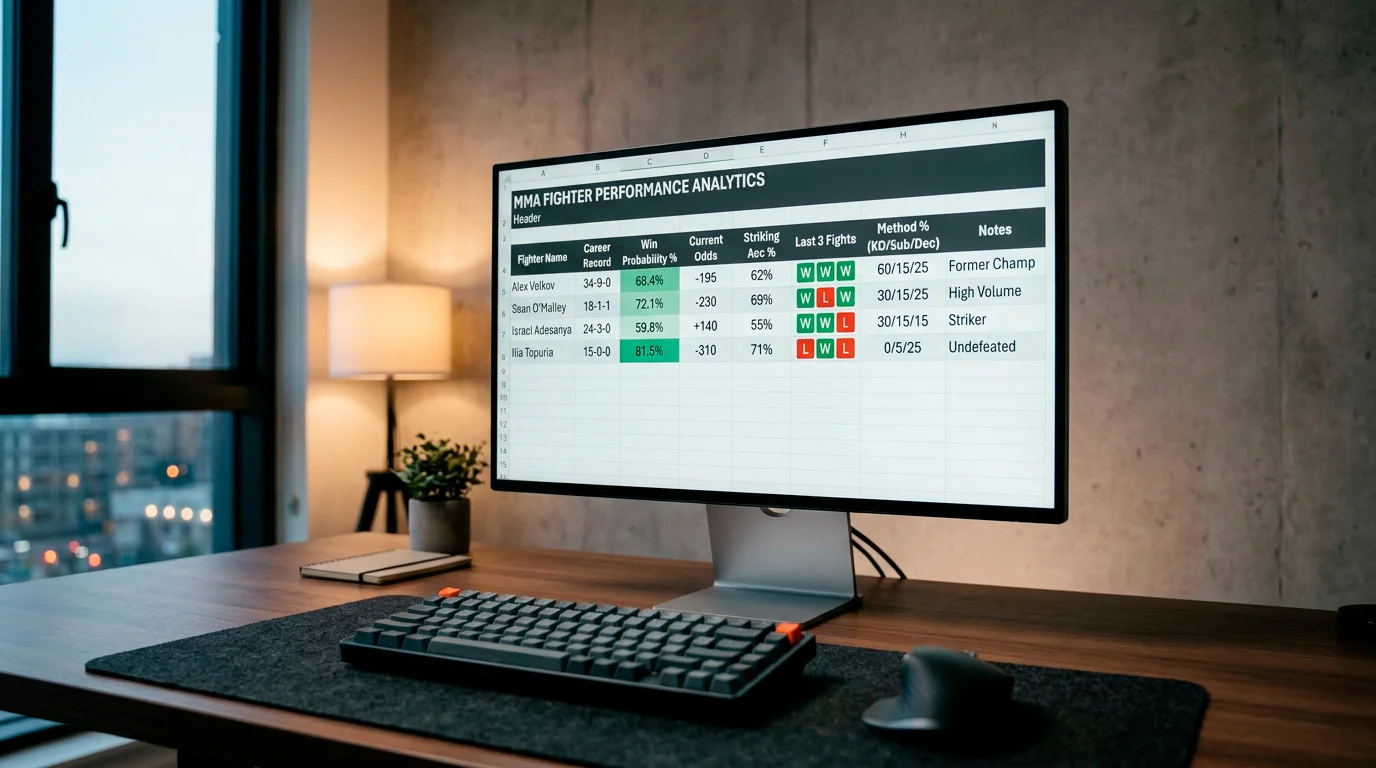
Five years ago, my UFC betting process involved reading a few preview articles, glancing at fighter records, and trusting my gut. My ROI was essentially flat. Today, every bet I place starts with data, fight statistics, historical matchup patterns, odds movement tracking, and the improvement has been steady and measurable. UFC GGR has grown at a compound annual rate exceeding 18% over the past five years, per Fight Matrix, which means the market is getting bigger and more competitive. The bettors who survive and profit in that environment are the ones who bring data to a game that most people play on instinct.
Free Data Sources: UFC Stats, Tapology and Sherdog
The best starting point costs nothing. The UFC’s official statistics platform publishes detailed fighter data – significant strikes landed and absorbed per minute, striking accuracy, takedown accuracy and defence, submission averages – for every fighter on the active roster. This is the same data that bookmakers’ trading desks use as a baseline for pricing fights, which means you are working from the same raw material.
The limitation of UFC Stats is context. The numbers tell you what happened but not against whom. A fighter with 55% striking accuracy looks impressive until you discover that his last three opponents were debuting fighters with poor defensive skills. That is where supplementary platforms add value.
Tapology provides fight histories with detailed opponent records, event contexts, and community ratings that offer a crowd-sourced perspective on fighter quality. Sherdog covers a broader range of MMA promotions, which is useful for researching fighters who recently entered the UFC from regional organisations. The global MMA market expanded from roughly 100 major events in 2020 to over 200 by 2025, per PTF Lab estimates, and these platforms track data across all of them – not just UFC.
Between these three free resources, you have enough data to build a research process that surpasses what 90% of recreational bettors bring to fight night. The key is consistency: use the same sources in the same order for every fight, and your pattern recognition will sharpen naturally.
One practical tip: when using UFC Stats, export the data into your own spreadsheet rather than relying on the website’s interface. The site presents career averages, but what you need for betting is recency-weighted data, the stats from a fighter’s last three to five bouts, ideally against comparable opposition. Building a simple database with per-fight data lets you calculate these recency-weighted metrics yourself, giving you a more accurate picture than the career averages that most bettors rely on.
Paid Platforms and Analytical Services
When free data is not enough, paid platforms offer deeper analysis – but the value proposition varies enormously, and I have wasted money on services that delivered less than a well-used spreadsheet.
The paid tools worth considering fall into three categories. First, odds tracking services that record line movements across multiple bookmakers, showing you when and how UFC odds shift throughout fight week. These tools turn line shopping from a manual comparison into a systematic process, and the best ones alert you to significant movements that indicate sharp money entering the market.
Second, statistical modelling platforms that apply algorithmic analysis to fighter data. These services ingest the same raw statistics from UFC Stats but apply regression models, Elo ratings, or machine learning to generate probability estimates for each fight. The output is a set of implied probabilities that you can compare against bookmaker odds to identify value. The quality varies – some models are genuinely predictive, others are backtested beautifully but fail on live data.
Third, tipster or advisory services that provide fight-by-fight picks with analysis. I approach these with scepticism. Any service can show a profitable track record by cherry-picking periods; what matters is verified, long-term results across a meaningful sample of events. If a service cannot provide transparent, independently tracked results, the subscription fee is likely better spent on your own data tools.
My recommendation: start with free tools, build your own process, and add a paid odds tracker once you are placing enough bets to justify the cost. The analytical platforms are worth exploring if you enjoy the modelling aspect, but they are not a prerequisite for profitable UFC betting.
Building a Simple UFC Betting Model
You do not need a computer science degree to build a functional betting model. You need a spreadsheet, the willingness to be disciplined about data entry, and a clear understanding of what you are trying to estimate.
The simplest model I have used assigns weights to five key metrics: significant striking differential (landed minus absorbed per minute), takedown accuracy, takedown defence, significant strike defence, and average fight time. Each metric produces a score for each fighter, and the combined score translates into a win probability estimate via a calibration table built from historical results.
Building the calibration table requires work. You backtest the model against the last two to three years of UFC results: feed in the pre-fight metrics for both fighters, generate a prediction, and compare it to the actual outcome. Over a hundred or more fights, you identify which metric weightings produce the most accurate probability estimates, and you adjust until the model’s predicted probabilities align with observed outcomes.
The model is not a crystal ball – it misses stylistic nuance, training camp changes, injuries, and the psychological factors that shape fight-night performance. What it does provide is a baseline probability estimate that is more rigorous than gut feeling and more specific than a bookmaker’s opening line. When my model’s probability differs from the bookmaker’s implied probability by more than five percentage points, I investigate further. When the gap exceeds eight to ten points and the qualitative analysis supports the model, I bet.
Maintaining the model takes about an hour per week during fight season: entering results, updating fighter stats, and recalibrating weights quarterly. That time investment pays for itself many times over in selection quality and decision confidence. The fighter stats guide covers which specific metrics to prioritise and how to interpret them in the context of different weight classes and fighting styles.
Is UFC Stats the most reliable free data source for betting?
UFC Stats is the most comprehensive free source for official fight statistics, and its data is used by bookmakers as a pricing baseline. However, it lacks context about opponent quality and historical rankings. Supplementing with Tapology or Sherdog for fight histories and opponent records produces a more complete picture.
Do paid UFC analytics tools actually improve betting results?
Results vary significantly. Odds tracking tools that facilitate line shopping provide a measurable, consistent return improvement. Statistical modelling platforms can improve selection quality if the underlying model is genuinely predictive, but poorly built models underperform a disciplined manual process. Verify any platform’s claims with independently tracked results before committing.
Written by the editors at ufc Betting uk.